a ball is dropped from rest and takes 1.3 s to hit the ground. from what height was it dropped?
Chapter 2 Ane-Dimensional Kinematics
13 2.seven Falling Objects
Summary
- Depict the effects of gravity on objects in motion.
- Describe the movement of objects that are in free fall.
- Summate the position and velocity of objects in free fall.
Falling objects form an interesting class of motion bug. For example, we can estimate the depth of a vertical mine shaft by dropping a rock into information technology and listening for the rock to hit the bottom. By applying the kinematics adult and so far to falling objects, we can examine some interesting situations and learn much about gravity in the process.
Gravity
The most remarkable and unexpected fact about falling objects is that, if air resistance and friction are negligible, then in a given location all objects fall toward the center of World with the same constant acceleration, independent of their mass. This experimentally determined fact is unexpected, considering nosotros are and so accepted to the effects of air resistance and friction that we wait light objects to fall slower than heavy ones.
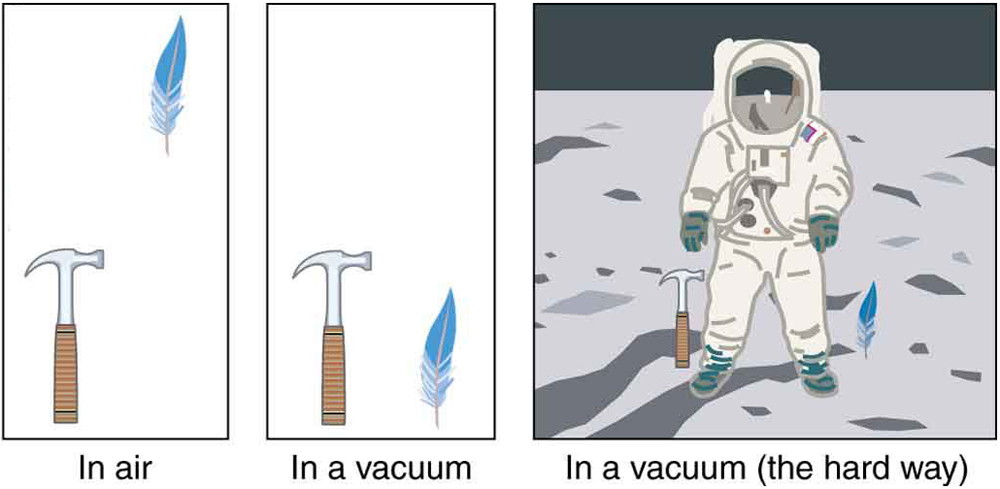
In the real globe, air resistance can crusade a lighter object to fall slower than a heavier object of the same size. A lawn tennis ball volition reach the ground afterward a hard baseball game dropped at the same time. (It might exist difficult to detect the difference if the height is non large.) Air resistance opposes the movement of an object through the air, while friction between objects—such as between clothes and a laundry chute or between a stone and a pool into which it is dropped—also opposes motion betwixt them. For the ideal situations of these first few capacity, an object falling without air resistance or friction is defined to exist in free-autumn .
The strength of gravity causes objects to autumn toward the center of Earth. The dispatch of gratuitous-falling objects is therefore called the acceleration due to gravity . The acceleration due to gravity is constant, which means we tin apply the kinematics equations to whatever falling object where air resistance and friction are negligible. This opens a broad class of interesting situations to us. The acceleration due to gravity is then important that its magnitude is given its ain symbol, gg size 12{g} {}. Information technology is constant at whatsoever given location on Earth and has the average value
[latex]\boldsymbol{grand\:=\:9.80\textbf{ grand/s}^ii.}[/latex]
Although[latex]\boldsymbol{thousand}[/latex]varies from[latex]\boldsymbol{9.78\textbf{ m/s}^2}[/latex]to[latex]\boldsymbol{9.83\textbf{ m/s}^ii}[/latex], depending on breadth, altitude, underlying geological formations, and local topography, the average value of[latex]\boldsymbol{9.80\textbf{ thousand/s}^2}[/latex]will be used in this text unless otherwise specified. The direction of the acceleration due to gravity is downward (towards the heart of Earth). In fact, its management defines what nosotros phone call vertical. Note that whether the acceleration[latex]\boldsymbol{a}[/latex]in the kinematic equations has the value[latex]\boldsymbol{+g}[/latex]or[latex]\boldsymbol{-g}[/latex]depends on how nosotros define our coordinate system. If we define the upward direction as positive, then[latex]\boldsymbol{a=-g=-9.lxxx\textbf{ m/s}^two}[/latex], and if we define the down direction as positive, and then[latex]\boldsymbol{a=grand=9.eighty\textbf{ 1000/s}^2}[/latex].
I-Dimensional Motility Involving Gravity
The all-time way to come across the bones features of move involving gravity is to kickoff with the simplest situations and then progress toward more complex ones. So we start by considering direct upwards and downward movement with no air resistance or friction. These assumptions hateful that the velocity (if there is any) is vertical. If the object is dropped, nosotros know the initial velocity is cypher. Once the object has left contact with any held or threw it, the object is in free-autumn. Under these circumstances, the movement is one-dimensional and has constant dispatch of magnitude[latex]\boldsymbol{g}.[/latex]We will likewise represent vertical deportation with the symbol[latex]\boldsymbol{y}[/latex]and use[latex]\boldsymbol{10}[/latex]for horizontal displacement.
KINEMATIC EQUATIONS FOR OBJECTS IN FREE Fall WHERE Acceleration = -G
[latex]\boldsymbol{five=v_0-gt}[/latex]
[latex]\boldsymbol{y=y_0+v_0t-}[/latex][latex]\boldsymbol{\frac{1}{ii}}[/latex][latex]\boldsymbol{gt^two}[/latex]
[latex]\boldsymbol{v^ii=v_0^2-2g(y-y_0)}[/latex]
Example one: Calculating Position and Velocity of a Falling Object: A Rock Thrown Upward
A person continuing on the edge of a loftier cliff throws a stone directly up with an initial velocity of 13.0 grand/due south. The stone misses the edge of the cliff equally it falls back to earth. Calculate the position and velocity of the rock 1.00 s, 2.00 s, and 3.00 s after information technology is thrown, neglecting the effects of air resistance.
Strategy
Draw a sketch.
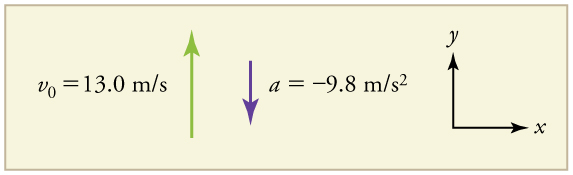
Nosotros are asked to make up one's mind the position[latex]\boldsymbol{y}[/latex]at various times. It is reasonable to take the initial position[latex]\boldsymbol{y_0}[/latex]to be zero. This problem involves one-dimensional motion in the vertical direction. We use plus and minus signs to bespeak direction, with up beingness positive and down negative. Since upwardly is positive, and the stone is thrown upwardly, the initial velocity must exist positive too. The acceleration due to gravity is downward, so[latex]\boldsymbol{a}[/latex]is negative. It is crucial that the initial velocity and the acceleration due to gravity have opposite signs. Opposite signs betoken that the acceleration due to gravity opposes the initial move and volition tiresome and eventually contrary information technology.
Since we are asked for values of position and velocity at three times, nosotros volition refer to these as[latex]\boldsymbol{y_1}[/latex]and[latex]\boldsymbol{v_1}[/latex];[latex]\boldsymbol{y_2}[/latex]and[latex]\boldsymbol{v_2}[/latex]; and[latex]\boldsymbol{y_3}[/latex]and[latex]\boldsymbol{v_3}[/latex].
Solution for Position [latex]\boldsymbol{y_1}[/latex]
ane. Place the knowns. Nosotros know that[latex]\boldsymbol{y_0=0}[/latex];[latex]\boldsymbol{v_0=13.0\textbf{ one thousand/southward}}[/latex];[latex]\boldsymbol{a=-one thousand=-9.80\textbf{ g/south}^2}[/latex]; and[latex]\boldsymbol{t=1.00\textbf{ s}}[/latex].
ii. Identify the best equation to use. We volition use[latex]\boldsymbol{y=y_0+v_0t+\frac{1}{2}at^2}[/latex]considering information technology includes but one unknown,[latex]\boldsymbol{y}[/latex](or[latex]\boldsymbol{y_1}[/latex], here), which is the value we want to notice.
3. Plug in the known values and solve for[latex]\boldsymbol{y_1}[/latex].
[latex]\boldsymbol{y_1=0+(13.0\textbf{ yard/s})(one.00\textbf{ s})+}[/latex][latex]\boldsymbol{\frac{1}{2}}[/latex][latex]\boldsymbol{(-9.80\textbf{ m/s}^2)(1.00\textbf{ s})^2=8.10\textbf{ m}}[/latex]
Discussion
The rock is 8.x m above its starting point at[latex]\boldsymbol{t=1.00}[/latex]due south, since[latex]\boldsymbol{y_1>y_0}[/latex]. It could be moving up or down; the only manner to tell is to calculate[latex]\boldsymbol{v_1}[/latex]and find out if information technology is positive or negative.
Solution for Velocity [latex]\boldsymbol{v_1}[/latex]
1. Identify the knowns. Nosotros know that[latex]\boldsymbol{y_0=0}[/latex];[latex]\boldsymbol{v_0=thirteen.0\textbf{ yard/s}}[/latex];[latex]\boldsymbol{a=-g=-9.80\textbf{ chiliad/south}^ii}[/latex]; and[latex]\boldsymbol{t=1.00\textbf{ due south}}[/latex]. We also know from the solution above that[latex]\boldsymbol{y_1=eight.ten\textbf{ m}}[/latex].
2. Place the best equation to use. The about straightforward is[latex]\boldsymbol{v=v_0-gt}[/latex](from[latex]\boldsymbol{five=v_0+at}[/latex], where[latex]\boldsymbol{a=\textbf{gravitational acceleration}=-g}[/latex]).
three. Plug in the knowns and solve.
[latex]\boldsymbol{v_1=v_0-gt=13.0\textbf{ m/south}-(nine.80\textbf{ m/southward}^2)(1.00\textbf{ southward})=3.xx\textbf{ thousand/southward}}[/latex]
Discussion
The positive value for[latex]\boldsymbol{v_1}[/latex]means that the rock is even so heading upward at[latex]\boldsymbol{t=1.00\textbf{ southward}}[/latex]. However, it has slowed from its original 13.0 thou/s, equally expected.
Solution for Remaining Times
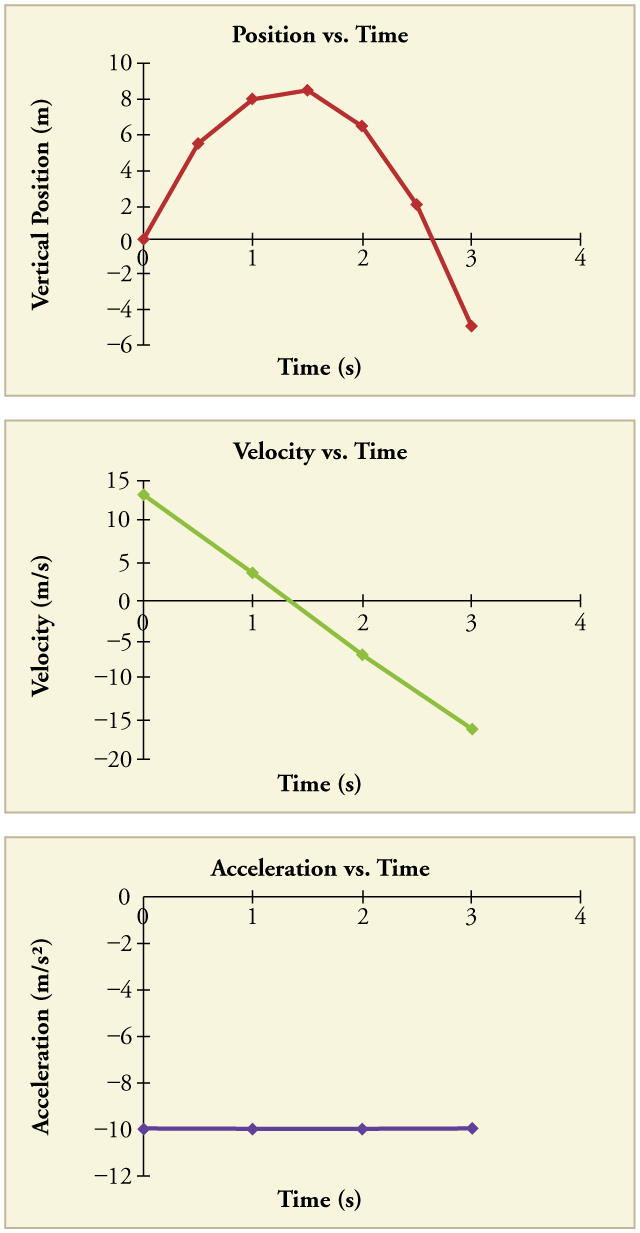
The procedures for calculating the position and velocity at[latex]\boldsymbol{t=ii.00\textbf{ s}}[/latex]and[latex]\boldsymbol{3.00\textbf{ s}}[/latex]are the same as those above. The results are summarized in Table 1 and illustrated in Figure 3.
| Time, t | Position, y | Velocity, v | Acceleration, a |
|---|---|---|---|
| 1.00 southward | viii.10 m | three.20 k/s | −9.80 m/s2 |
| 2.00 s | 6.forty m | −6.threescore m/s | −9.80 m/s2 |
| three.00 southward | −5.10 m | −16.4 chiliad/s | −ix.80 m/s2 |
| Table 1. Results. | |||
Graphing the data helps us understand it more clearly.
Discussion
The interpretation of these results is important. At ane.00 southward the rock is in a higher place its starting bespeak and heading up, since[latex]\boldsymbol{y_1}[/latex]and[latex]\boldsymbol{v_1}[/latex]are both positive. At 2.00 southward, the rock is withal to a higher place its starting point, but the negative velocity means it is moving downward. At 3.00 s, both[latex]\boldsymbol{y_3}[/latex]and[latex]\boldsymbol{v_3}[/latex]are negative, meaning the rock is beneath its starting point and standing to motility downward. Notice that when the rock is at its highest point (at 1.v s), its velocity is zero, but its acceleration is notwithstanding[latex]\boldsymbol{-ix.80\textbf{ m/due south}^2}[/latex]. Its acceleration is[latex]\boldsymbol{-9.80\textbf{ g/s}^2}[/latex]for the whole trip—while information technology is moving up and while it is moving down. Annotation that the values for[latex]\boldsymbol{y}[/latex]are the positions (or displacements) of the rock, not the total distances traveled. Finally, notation that complimentary-autumn applies to upwardly motion as well as downwardly. Both have the aforementioned acceleration—the dispatch due to gravity, which remains constant the entire fourth dimension. Astronauts training in the famous Vomit Comet, for instance, feel free-fall while arcing up as well as down, as we will discuss in more detail later.
MAKING CONNECTIONS: TAKE HOME EXPERIMENT—REACTION Fourth dimension
A simple experiment tin can be done to determine your reaction time. Accept a friend hold a ruler between your thumb and index finger, separated past nigh 1 cm. Note the marker on the ruler that is right betwixt your fingers. Have your friend drib the ruler unexpectedly, and try to catch it betwixt your ii fingers. Annotation the new reading on the ruler. Assuming acceleration is that due to gravity, calculate your reaction fourth dimension. How far would y'all travel in a auto (moving at xxx m/s) if the time it took your foot to go from the gas pedal to the brake was twice this reaction time?
Case 2: Computing Velocity of a Falling Object: A Rock Thrown Downwards
What happens if the person on the cliff throws the rock straight down, instead of straight up? To explore this question, calculate the velocity of the stone when information technology is v.x m beneath the starting indicate, and has been thrown down with an initial speed of 13.0 1000/south.
Strategy
Draw a sketch.
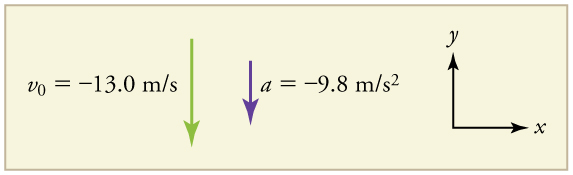
Since up is positive, the final position of the stone will be negative because it finishes below the starting point at[latex]\boldsymbol{y_0=0}[/latex]. Similarly, the initial velocity is downward and therefore negative, as is the dispatch due to gravity. We expect the final velocity to be negative since the rock will continue to move downward.
Solution
1. Place the knowns.[latex]\boldsymbol{y_0=0}[/latex];[latex]\boldsymbol{y_1=-five.10\textbf{ m}}[/latex];[latex]\boldsymbol{v_0=-13.0\textbf{ m/southward}}[/latex];[latex]\boldsymbol{a=-g=-9.80\textbf{ m/s}^ii}[/latex].
2. Cull the kinematic equation that makes it easiest to solve the trouble. The equation[latex]\boldsymbol{v^2=v_0^2+2a(y-y_0)}[/latex]works well because the only unknown in it is[latex]\boldsymbol{v}[/latex]. (We volition plug[latex]\boldsymbol{y_1}[/latex]in for[latex]\boldsymbol{y}[/latex].)
3. Enter the known values
[latex]\boldsymbol{five^2=(-13.0\textbf{ m/s})^2+ii(-9.80\textbf{ m/s}^two)(-5.10\textbf{ m}-0\textbf{ m})=268.96\textbf{ thousand}^ii/\textbf{s}^2}[/latex],
where we have retained extra significant figures considering this is an intermediate result.
Taking the foursquare root, and noting that a foursquare root can be positive or negative, gives
[latex]\boldsymbol{v=\pm16.iv\textbf{ chiliad/southward}}[/latex].
The negative root is chosen to indicate that the rock is still heading downwards. Thus,
[latex]\boldsymbol{v=-16.iv\textbf{ m/s.}}[/latex]
Discussion
Note that this is exactly the same velocity the rock had at this position when it was thrown straight upward with the same initial speed. (Come across Example 1 and Effigy 5(a).) This is not a casual result. Because nosotros only consider the acceleration due to gravity in this problem, the speed of a falling object depends only on its initial speed and its vertical position relative to the starting point. For instance, if the velocity of the rock is calculated at a height of 8.ten m above the starting bespeak (using the method from Example i) when the initial velocity is 13.0 one thousand/s directly upwardly, a event of[latex]\boldsymbol{\pm3.twenty\textbf{ m/s}}[/latex]is obtained. Here both signs are meaningful; the positive value occurs when the stone is at eight.x m and heading upwardly, and the negative value occurs when the rock is at eight.10 m and heading dorsum down. It has the same speed merely the opposite management.
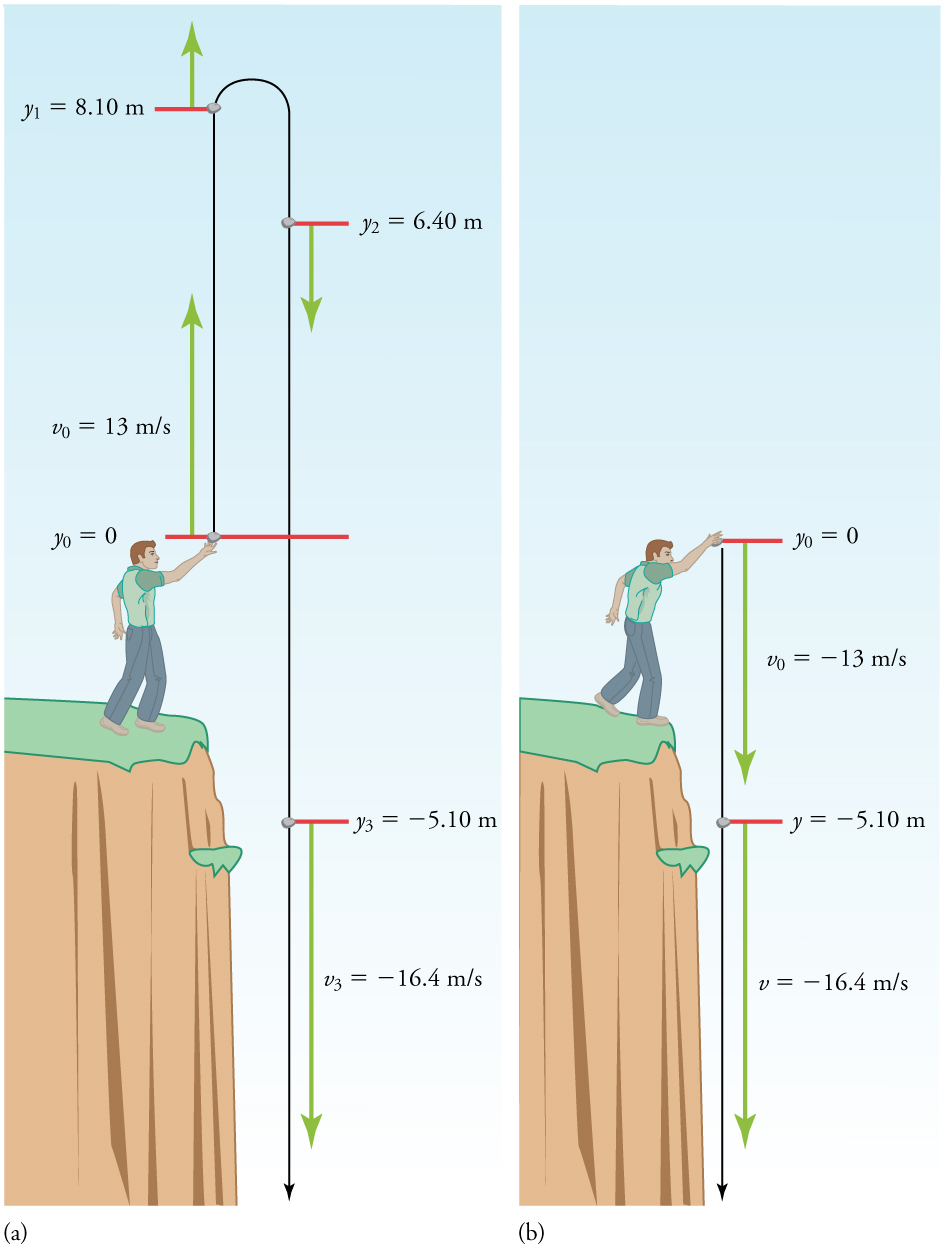
Another manner to look at it is this: In Instance 1, the rock is thrown up with an initial velocity of[latex]\boldsymbol{13.0\textbf{ one thousand/s}}[/latex]. It rises and and so falls back down. When its position is[latex]\boldsymbol{y=0}[/latex]on its way dorsum downwards, its velocity is[latex]\boldsymbol{-13.0\textbf{ g/s}}[/latex]. That is, it has the same speed on its way down equally on its manner upward. We would then expect its velocity at a position of[latex]\boldsymbol{y=-5.10\textbf{ m}}[/latex]to be the aforementioned whether we take thrown information technology upwards at[latex]\boldsymbol{+xiii.0\textbf{ thousand/s}}[/latex]or thrown it downwardly at[latex]\boldsymbol{-13.0\textbf{ grand/southward}}.[/latex]The velocity of the rock on its way downward from[latex]\boldsymbol{y=0}[/latex]is the same whether we have thrown it up or down to showtime with, equally long as the speed with which it was initially thrown is the same.
Example iii: Find yard from Data on a Falling Object
The acceleration due to gravity on Earth differs slightly from place to place, depending on topography (eastward.chiliad., whether y'all are on a hill or in a valley) and subsurface geology (whether at that place is dumbo stone like fe ore as opposed to low-cal rock similar table salt beneath you.) The precise acceleration due to gravity tin can be calculated from data taken in an introductory physics laboratory class. An object, unremarkably a metal ball for which air resistance is negligible, is dropped and the time it takes to autumn a known distance is measured. Run across, for example, Effigy 6. Very precise results tin be produced with this method if sufficient care is taken in measuring the distance fallen and the elapsed time.
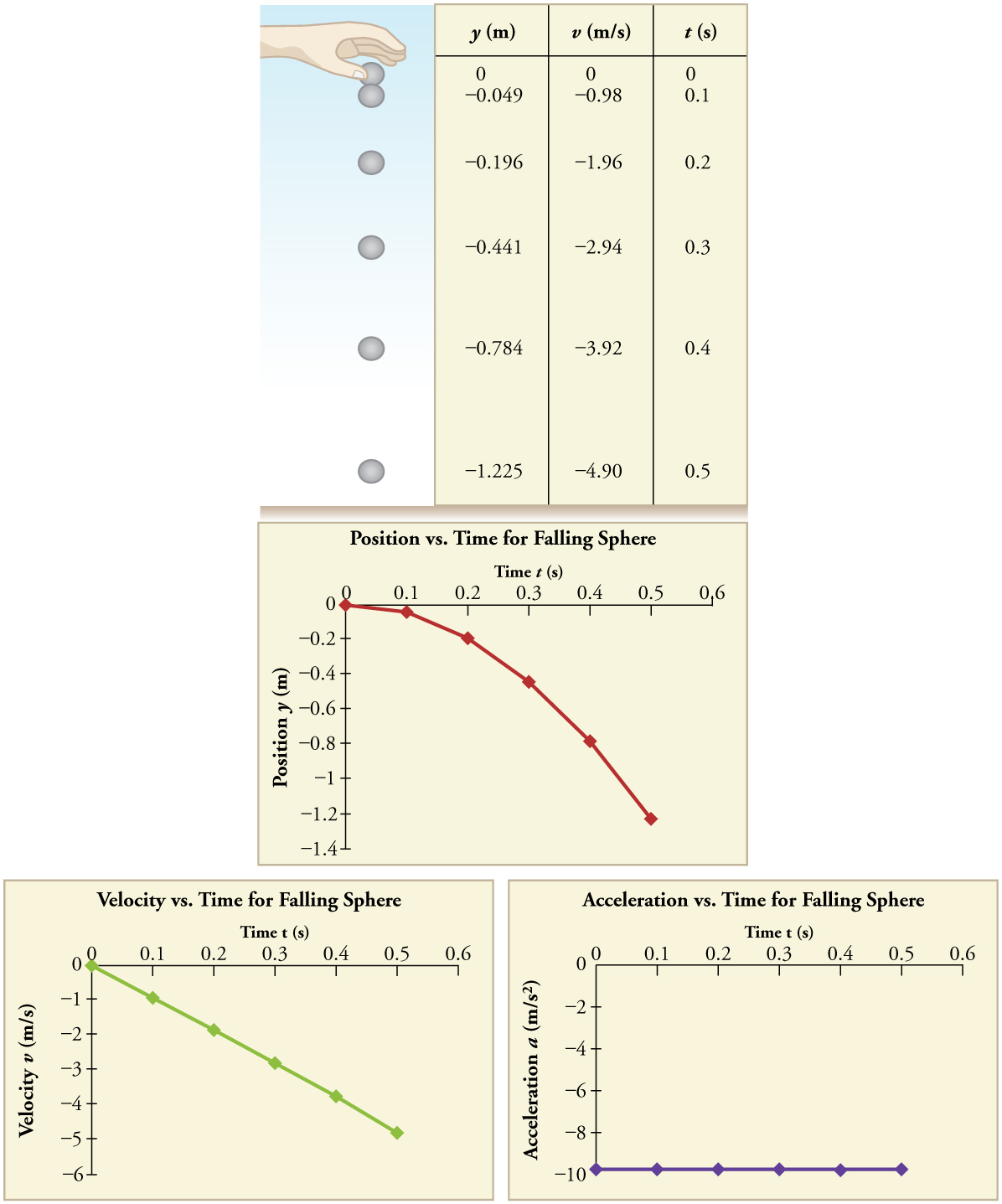
Suppose the ball falls 1.0000 1000 in 0.45173 s. Assuming the ball is not affected by air resistance, what is the precise dispatch due to gravity at this location?
Strategy
Draw a sketch.
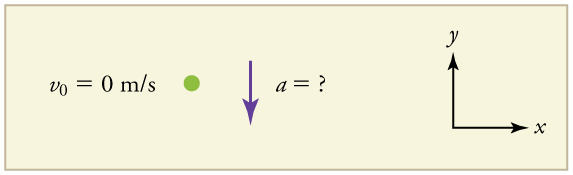
We need to solve for dispatch[latex]\boldsymbol{a}[/latex]. Note that in this case, displacement is downward and therefore negative, as is acceleration.
Solution
1. Place the knowns.[latex]\boldsymbol{y_0=0}[/latex];[latex]\boldsymbol{y=-i.0000\textbf{ 1000}}[/latex];[latex]\boldsymbol{t=0.45173\textbf{ southward}}[/latex];[latex]\boldsymbol{v_0=0}.[/latex]
2. Choose the equation that allows you to solve for[latex]\boldsymbol{a}[/latex]using the known values.
[latex]\boldsymbol{y=y_0+v_0t+\frac{1}{two}at^2}[/latex]
3. Substitute 0 for[latex]\boldsymbol{v_0}[/latex]and rearrange the equation to solve for[latex]\boldsymbol{a}[/latex]. Substituting 0 for[latex]\boldsymbol{v_0}[/latex]yields
[latex]\boldsymbol{y=y_0+\frac{one}{2}at^ii.}[/latex]
Solving for[latex]\boldsymbol{a}[/latex]gives
[latex]\boldsymbol{a=}[/latex][latex]\boldsymbol{\frac{2(y-y_0)}{t^ii}.}[/latex]
iv. Substitute known values yields
[latex]\boldsymbol{a=}[/latex][latex]\boldsymbol{\frac{2(-i.0000\textbf{ k} - 0)}{(0.45173\textbf{ s})^2}}[/latex][latex]\boldsymbol{=-9.8010\textbf{ m/s}^2,}[/latex]
so, considering[latex]\boldsymbol{a=-g}[/latex]with the directions nosotros take called,
[latex]\boldsymbol{g=ix.8010\textbf{ m/s}^two.}[/latex]
Word
The negative value for[latex]\boldsymbol{a}[/latex]indicates that the gravitational dispatch is downward, as expected. Nosotros expect the value to be somewhere around the average value of[latex]\boldsymbol{9.80\textbf{ m/s}^two,}[/latex] so[latex]\boldsymbol{nine.8010\textbf{ k/s}^2}[/latex]makes sense. Since the data going into the calculation are relatively precise, this value for[latex]\boldsymbol{g}[/latex]is more precise than the average value of[latex]\boldsymbol{9.80\textbf{ 1000/due south}^2}[/latex]; it represents the local value for the acceleration due to gravity.
Check Your Agreement
1: A chunk of ice breaks off a glacier and falls 30.0 meters before it hits the water. Bold it falls freely (there is no air resistance), how long does information technology take to hit the h2o?
PHET EXPLORATIONS: EQUATION GRAPHER
Learn nearly graphing polynomials. The shape of the curve changes as the constants are adjusted. View the curves for the individual terms (eastward.g.[latex]\boldsymbol{y=bx}[/latex]) to see how they add to generate the polynomial curve.

Section Summary
- An object in gratis-autumn experiences constant acceleration if air resistance is negligible.
- On Earth, all free-falling objects have an acceleration due to gravity[latex]\boldsymbol{chiliad}[/latex], which averages
[latex]\boldsymbol{grand=nine.lxxx\textbf{ m/southward}^2}[/latex].
- Whether the acceleration a should be taken equally[latex]\boldsymbol{+yard}[/latex]or[latex]\boldsymbol{-g}[/latex]is determined past your selection of coordinate arrangement. If you choose the upward management as positive,[latex]\boldsymbol{a=-g=-9.80\textbf{ grand/s}^2}[/latex] is negative. In the reverse case,[latex]\boldsymbol{a=+g=ix.80\textbf{ m/s}^2}[/latex]is positive. Since acceleration is abiding, the kinematic equations higher up can be applied with the advisable[latex]\boldsymbol{+g}[/latex]or[latex]\boldsymbol{-one thousand}[/latex]substituted for[latex]\boldsymbol{a}[/latex].
- For objects in costless-fall, upward is usually taken every bit positive for displacement, velocity, and dispatch.
Conceptual Questions
i: What is the acceleration of a stone thrown straight upward on the style upward? At the top of its flight? On the mode downwards?
ii: An object that is thrown straight up falls back to Globe. This is 1-dimensional motility. (a) When is its velocity null? (b) Does its velocity change management? (c) Does the acceleration due to gravity have the same sign on the style up every bit on the style down?
iii: Suppose you throw a stone most direct upwardly at a kokosnoot in a palm tree, and the rock misses on the way up but hits the coconut on the fashion downwards. Neglecting air resistance, how does the speed of the rock when it hits the kokosnoot on the mode downwardly compare with what it would have been if it had hitting the coconut on the way up? Is it more likely to dislodge the coconut on the way upwardly or downward? Explain.
4: If an object is thrown straight up and air resistance is negligible, then its speed when it returns to the starting signal is the same as when it was released. If air resistance were non negligible, how would its speed upon return compare with its initial speed? How would the maximum height to which it rises be affected?
five: The severity of a autumn depends on your speed when you strike the footing. All factors but the acceleration due to gravity being the same, how many times higher could a safe autumn on the Moon be than on Earth (gravitational acceleration on the Moon is about one/vi that of the Earth)?
6: How many times higher could an astronaut spring on the Moon than on Globe if his takeoff speed is the same in both locations (gravitational acceleration on the Moon is about ane/half-dozen of[latex]\boldsymbol{g}[/latex]on Earth)?
Bug & Exercises
Presume air resistance is negligible unless otherwise stated.
1: Calculate the displacement and velocity at times of (a) 0.500, (b) 1.00, (c) i.fifty, and (d) 2.00 south for a ball thrown direct upward with an initial velocity of xv.0 m/s. Accept the signal of release to be[latex]\boldsymbol{y_0=0}.[/latex]
2: Calculate the displacement and velocity at times of (a) 0.500, (b) 1.00, (c) i.50, (d) 2.00, and (e) 2.50 south for a rock thrown straight down with an initial velocity of 14.0 m/southward from the Verrazano Narrows Bridge in New York City. The roadway of this bridge is 70.0 m to a higher place the h2o.
three: A basketball referee tosses the ball straight upwardly for the starting tip-off. At what velocity must a basketball player leave the basis to ascent 1.25 m higher up the floor in an endeavor to become the ball?
iv: A rescue helicopter is hovering over a person whose gunkhole has sunk. One of the rescuers throws a life preserver direct down to the victim with an initial velocity of 1.40 1000/s and observes that it takes 1.eight s to attain the water. (a) List the knowns in this trouble. (b) How high above the h2o was the preserver released? Note that the downdraft of the helicopter reduces the effects of air resistance on the falling life preserver, so that an dispatch equal to that of gravity is reasonable.
5: A dolphin in an aquatic show jumps straight upwards out of the water at a velocity of 13.0 m/s. (a) List the knowns in this problem. (b) How high does his body rise above the water? To solve this part, showtime note that the concluding velocity is now a known and identify its value. And then identify the unknown, and discuss how you chose the appropriate equation to solve for it. After choosing the equation, bear witness your steps in solving for the unknown, checking units, and discuss whether the answer is reasonable. (c) How long is the dolphin in the air? Neglect any furnishings due to his size or orientation.
6: A swimmer bounces straight upward from a diving board and falls anxiety first into a pool. She starts with a velocity of four.00 m/s, and her takeoff bespeak is i.80 m in a higher place the pool. (a) How long are her feet in the air? (b) What is her highest point above the board? (c) What is her velocity when her feet hit the h2o?
7: (a) Summate the pinnacle of a cliff if it takes 2.35 s for a rock to hit the ground when it is thrown straight up from the cliff with an initial velocity of 8.00 thou/s. (b) How long would information technology take to reach the ground if it is thrown directly down with the same speed?
8: A very strong, only inept, shot doodle puts the shot straight upwards vertically with an initial velocity of 11.0 chiliad/s. How long does he take to get out of the way if the shot was released at a pinnacle of two.20 yard, and he is 1.80 m alpine?
9: You throw a ball straight up with an initial velocity of 15.0 1000/southward. Information technology passes a tree branch on the way up at a summit of 7.00 m. How much additional time will pass before the ball passes the tree branch on the way back downward?
x: A kangaroo can spring over an object 2.50 k high. (a) Calculate its vertical speed when it leaves the ground. (b) How long is it in the air?
11: Continuing at the base of ane of the cliffs of Mt. Arapiles in Victoria, Australia, a hiker hears a rock interruption loose from a top of 105 m. He tin can't run into the rock right abroad but then does, 1.50 s afterwards. (a) How far to a higher place the hiker is the stone when he tin see it? (b) How much fourth dimension does he have to move earlier the rock hits his caput?
12: An object is dropped from a elevation of 75.0 thou higher up ground level. (a) Make up one's mind the distance traveled during the first 2nd. (b) Determine the final velocity at which the object hits the ground. (c) Determine the distance traveled during the terminal second of motion before striking the ground.
13: There is a 250-one thousand-high cliff at Half Dome in Yosemite National Park in California. Suppose a boulder breaks loose from the top of this cliff. (a) How fast will it be going when information technology strikes the ground? (b) Bold a reaction fourth dimension of 0.300 s, how long will a tourist at the bottom have to go out of the mode after hearing the sound of the stone breaking loose (neglecting the height of the tourist, which would get negligible anyway if hit)? The speed of sound is 335 m/s on this mean solar day.
14: A ball is thrown straight up. It passes a 2.00-thousand-high window seven.50 m off the footing on its path up and takes 0.312 s to become by the window. What was the ball'south initial velocity? Hint: Beginning consider only the distance along the window, and solve for the brawl'south velocity at the bottom of the window. Next, consider just the altitude from the ground to the bottom of the window, and solve for the initial velocity using the velocity at the bottom of the window as the last velocity.
xv: Suppose you drop a stone into a nighttime well and, using precision equipment, you measure the time for the sound of a splash to return. (a) Neglecting the time required for sound to travel up the well, calculate the distance to the h2o if the sound returns in 2.0000 s. (b) Now calculate the distance taking into account the time for sound to travel up the well. The speed of sound is 332.00 m/s in this well.
sixteen: A steel brawl is dropped onto a hard flooring from a height of 1.50 m and rebounds to a acme of 1.45 1000. (a) Calculate its velocity just before it strikes the floor. (b) Calculate its velocity just after it leaves the floor on its style dorsum up. (c) Calculate its dispatch during contact with the flooring if that contact lasts 0.0800 ms[latex]\boldsymbol{(8.00\times10^{-5}\textbf{ s})}.[/latex] (d) How much did the ball compress during its collision with the floor, bold the floor is absolutely rigid?
17: A coin is dropped from a hot-air airship that is 300 one thousand to a higher place the ground and rising at x.0 yard/s upwards. For the coin, notice (a) the maximum tiptop reached, (b) its position and velocity 4.00 due south after being released, and (c) the fourth dimension before it hits the ground.
18: A soft tennis brawl is dropped onto a difficult floor from a peak of 1.l yard and rebounds to a height of one.ten m. (a) Calculate its velocity just before it strikes the floor. (b) Calculate its velocity just afterward it leaves the floor on its style dorsum upwards. (c) Calculate its acceleration during contact with the floor if that contact lasts three.fifty ms[latex]\boldsymbol{(3.fifty\times10^{-3}\textbf{ due south})}.[/latex] (d) How much did the ball shrink during its standoff with the floor, assuming the floor is absolutely rigid?
Glossary
- free-fall
- the state of movement that results from gravitational force simply
- dispatch due to gravity
- acceleration of an object equally a result of gravity
Solutions
Check Your Agreement
1: We know that initial position[latex]\boldsymbol{y_0=0}[/latex], last position[latex]\boldsymbol{y=-30.0\textbf{ m}}[/latex], and[latex]\boldsymbol{a=-g=-9.80\textbf{ one thousand/s}^2}[/latex]. We can then use the equation[latex]\boldsymbol{y=y_0+v_0t+\frac{one}{2}at^2}[/latex]to solve for[latex]\boldsymbol{t}[/latex]. Inserting[latex]\boldsymbol{a=-one thousand}[/latex], nosotros obtain
[latex]\boldsymbol{y=0+0-\frac{1}{2}gt^2}[/latex]
[latex]\boldsymbol{t^2=\frac{2y}{-g}}[/latex]
[latex]\boldsymbol{t=\pm\sqrt{\frac{2y}{-g}}=\pm\sqrt{\frac{2(-xxx.0\textbf{ m}}{-9.80\textbf{ m/s}^two}}=\pm\sqrt{6.12\textbf{ s}^2}=2.47\textbf{ s}\approx2.5\textbf{ s}}[/latex]
where we take the positive value as the physically relevant reply. Thus, information technology takes well-nigh 2.5 seconds for the piece of ice to hitting the h2o.
Problems & Exercises
one:
(a)[latex]\boldsymbol{y_1=6.28\textbf{ chiliad}};\boldsymbol{v_1=10.one\textbf{ m/southward}}[/latex]
(b)[latex]\boldsymbol{y_2=ten.ane\textbf{ k}};\boldsymbol{v_2=five.20\textbf{ m/s}}[/latex]
(c)[latex]\boldsymbol{y_3=11.5\textbf{ thou}};\boldsymbol{v_3=0.300\textbf{ m/s}}[/latex]
(d)[latex]\boldsymbol{y_4=10.four\textbf{ m}};\boldsymbol{v_4=-4.60\textbf{ m/s}}[/latex]
3:
[latex]\boldsymbol{v_0=4.95\textbf{ one thousand/s}}[/latex]
5:
(a)[latex]\boldsymbol{a=-9.80\textbf{ one thousand/southward}^two};\boldsymbol{v_0=thirteen.0\textbf{ m/s}};\boldsymbol{y_0=0\textbf{ m}}[/latex]
(b)[latex]\boldsymbol{v=0\textbf{ m/due south}}.[/latex]Unknown is distance[latex]\boldsymbol{y}[/latex]to top of trajectory, where velocity is zippo. Use equation[latex]\boldsymbol{five^2=v_0^2+2a(y-y_0)}[/latex]because it contains all known values except for[latex]\boldsymbol{y},[/latex]and then we tin solve for[latex]\boldsymbol{y}.[/latex]Solving for[latex]\boldsymbol{y}[/latex]gives
[latex]\brainstorm{array}{r @{{}={}} l} \boldsymbol{five^ii - v_0^ii} & \boldsymbol{2a(y - y_0)} \\[1em] \boldsymbol{\frac{5^two - v_0}{2a}} & \boldsymbol{y - y_0} \\[1em] \boldsymbol{y} & \boldsymbol{y_0 + \frac{5^ii - 5^2_0}{2a} = 0 \;\textbf{m} + \frac{(0 \;\textbf{yard/due south})^ii - (thirteen.0 \;\textbf{m/s})^2}{two(-9.eighty \;\textbf{m/due south}^2)} = eight.62 \;\textbf{one thousand}} \terminate{assortment}[/latex]
Dolphins measure out about two meters long and tin can jump several times their length out of the h2o, so this is a reasonable result.
(c)[latex]\boldsymbol{2.65\textbf{ due south}}[/latex]
7:
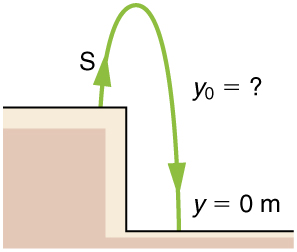
(a) 8.26 m
(b) 0.717 s
9:
1.91 s
11:
xiii:
(a) -70.0 chiliad/s (downward)
(b) 6.10 s
15:
(a)[latex]\boldsymbol{19.6\textbf{ m}}[/latex]
(b)[latex]\boldsymbol{18.5\textbf{ m}}[/latex]
17:
(a) 305 k
(b) 262 g, -29.2 m/s
(c) viii.91 s
Source: https://pressbooks.bccampus.ca/collegephysics/chapter/falling-objects/

Post a Comment for "a ball is dropped from rest and takes 1.3 s to hit the ground. from what height was it dropped?"