Protocol Analyzers Can Help Solve Problems From the Data Link Layer Up to the Application Layer.
Instructor Planning Guide
Activities
What activities are associated with this chapter?
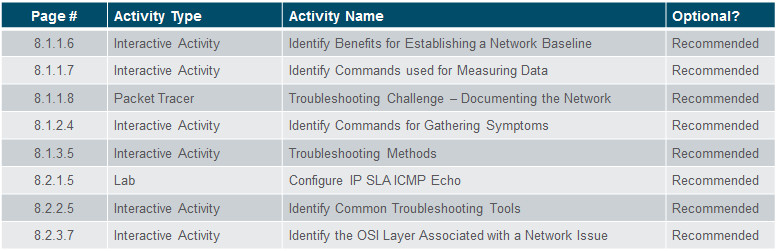
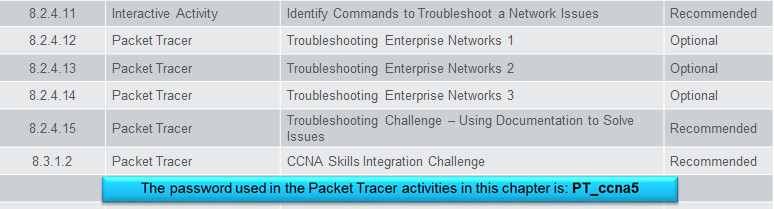
Assessment
Students should complete Chapter 8, "Assessment" subsequently completing Affiliate 8.
Quizzes, labs, Packet Tracers and other activities tin be used to informally assess student progress.
Sections & Objectives
8.ane Troubleshooting Methodology
Explain troubleshooting approaches for various network problems.
Explain how network documentation is developed and used to troubleshoot network issues.
Draw the full general troubleshooting procedure.
Compare troubleshooting methods that use a systematic, layered approach.
8.2 Troubleshooting Scenarios
Troubleshoot end-to-stop connectivity in a small to medium-sized business network, using a systematic approach.
Use an ICMP repeat-based IP SLA to troubleshoot network connectivity issues.
Describe different networking troubleshooting tools.
Determine the symptoms and causes of network problems using a layered model.
Troubleshoot a network using the layered model.
Affiliate 8: Network Troubleshooting
8.1 – Troubleshooting Methodology
8.1.1 – Network Documentation
8.1.1.one – Documenting the Network
For troubleshooting purposes, network administrators must have a consummate set up of accurate and current network documentation which includes:
- Configuration files, including network configure files and end-arrangement configuration files
- Physical and logical topology diagrams
- Baseline functioning levels
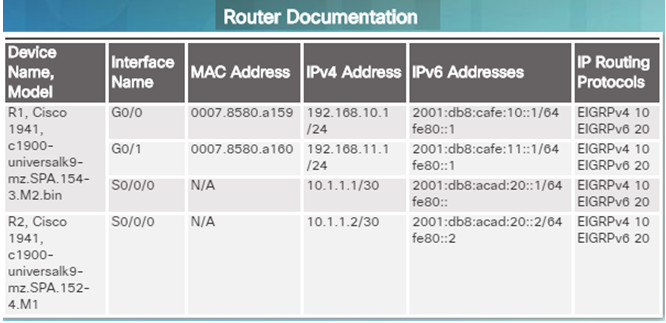
Network Configuration files should contain all relevant information nigh any devices including:
- Blazon of device, model designation
- IOS prototype name
- Device network hostname
- Location of the device
- If modular, include module/slot info
- If modular, include module/slot info
- Data link and network layer addresses
- Whatsoever boosted important information about physical aspects of the device
Stop-system configuration files focus on the hardware and software used on end-system devices such equally servers, network management consoles, and user workstations. Documentation should include:
- Device proper name (purpose)
- Operating system and version
- IPv4 and IPv6 addresses
- Subnet mask and prefix length
- Default gateway and DNS server
- Any loftier-bandwidth network applications used on the end system
8.one.1.two – Network Topology Diagrams
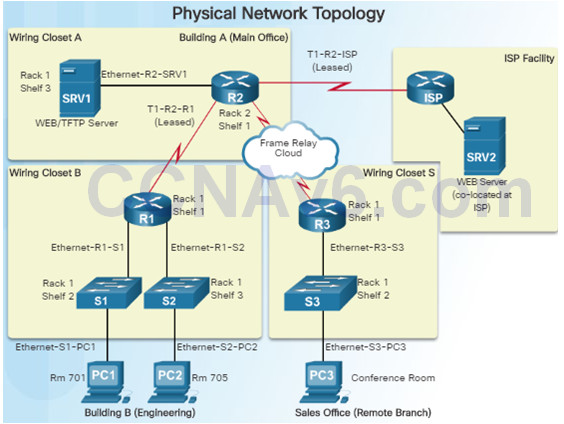
Network topology diagrams keep runway of the location, function, and condition of devices on the network. There are two types of topology diagrams:
- Concrete topology
- Logical topology
Concrete Topology network diagrams show the concrete layout of the devices connected to the network and typically include:
- Device type
- Model and manufacturer
- Operating Organization version
- Cablevision type and identifier
- Cable specification
- Connector blazon
- Cabling endpoints
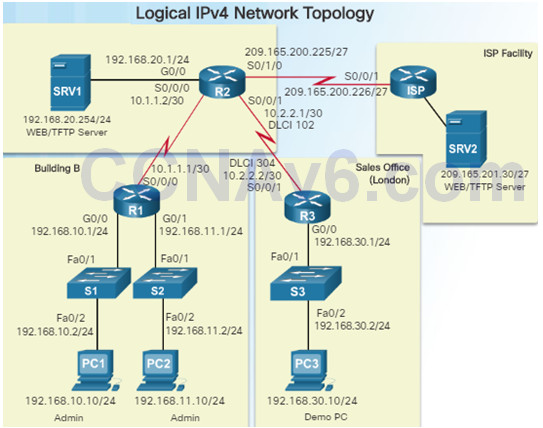
Logical network topology diagrams illustrate how devices are logically connected to the network
Symbols are used to correspond network elements, such every bit routers, servers, hosts, VPN concentrators, and security devices.
Documented data might include:
- Device identifiers
- IP address and prefix lengths
- Interface identifiers
- Connectedness type
- Frame Relay DLCI for virtual circuits (if applicable)
- Site-to-site VPNs
- Routing protocols and static routes
- WAN technologies used
- Data-link protocols
viii.1.1.3 – Establishing a Network Baseline
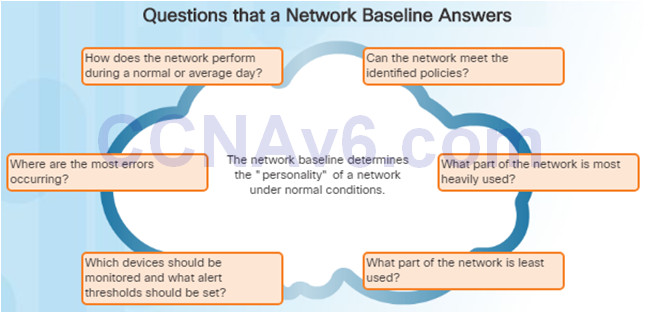
The purpose of network monitoring is to watch network performance in comparison to a predetermined baseline.
A network performance baseline
- Is used to establish normal network or system functioning
- Requires collecting performance data from the ports and devices that are essential to operation
- Allows the network administrator to determine the difference between aberrant behavior and proper network performance
Analysis after an initial baseline as well tends to reveal hidden issues. The nerveless data can show the true nature of congestion or potential congestion in a network.
8.1.one.4 – Steps to Establish a Network Baseline
Step ane: Determine what types of information to collect.
Start out with a few variables that represent the divers policy.
Not that capturing too many information points can be overwhelming making analysis hard.
Offset out merely, and fine-tune along the style.
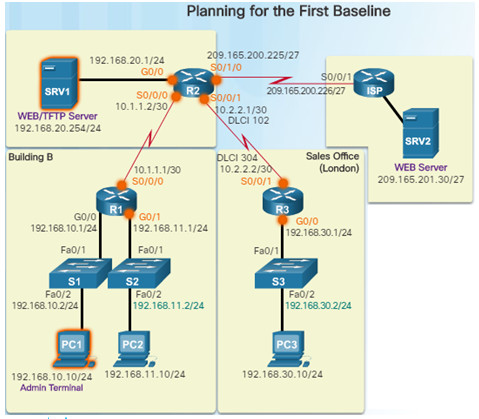
Step ii: Identify devices and ports of involvement.
Use the network topology to identify fundamental devices for which performance data should exist measured.
Devices and ports of involvement include network device ports that connect to other network devices, servers, and fundamental users.
Pace iii: Determine the baseline duration
The length of time and baseline information existence gathered must be sufficient for establishing a typical pic of the network.
Daily trends of network traffic should be measured.
Monitor for trends that occur over a longer period of fourth dimension such equally weekly or monthly.
Capture data trends and include:
Screenshots of CPU utilization trends captured over a daily, weekly, monthly, and yearly menstruation
Note: Baseline measurements should not be performed during times of unique traffic patterns.
8.1.1.five – Measuring Data
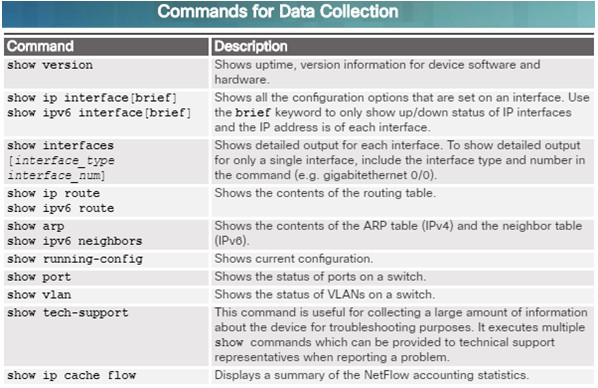
When documenting the network, it is necessary to assemble information straight from routers and switches.
Ping, traceroute, and t elnet are useful commands to certificate.
The figure to the left lists some of the most common Cisco IOS bear witness commands used for data drove.
Manual information drove using show commands on individual network devices is very fourth dimension consuming and is not a scalable solution. This should be reserved for smaller networks or mission critical devices.
Sophisticated network direction software is typically used to baseline large and complex networks.
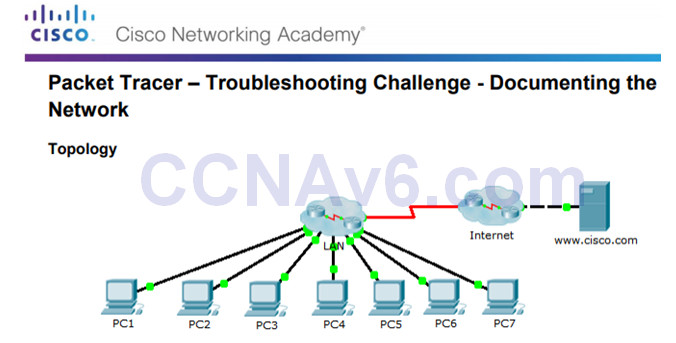
8.1.1.8 – Bundle Tracer – Troubleshooting Challenge – Documenting the Network
This activity covers the steps to take to discover a network using primarily the Telnet, testify cdp neighbors particular, and show ip route commands.
The topology in the figure to the left does non reveal all of the details of the network.
You will be require to use your cognition of networking and discovery commands to learn about the full network topology and document it.
8.one.ii – Troubleshooting Process
eight.1.two.1 – Full general Troubleshooting Procedures
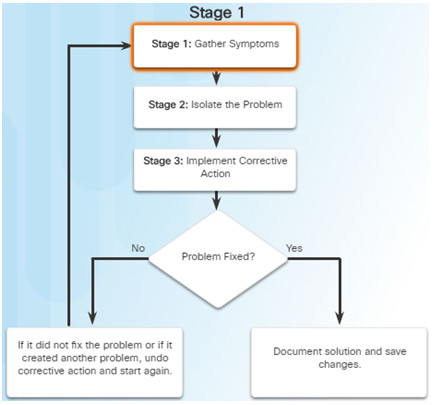
Using efficient troubleshooting techniques shortens overall troubleshooting time.
There are three major stages to the troubleshooting procedure:
Stage one. Get together symptoms –
- Gather and document symptoms from the network, end systems, and users.
- The network administrator determines which network components accept been afflicted and how the functionality of the network has inverse in comparison to the baseline.
- Symptoms may come up from the network management arrangement, console messages, and user complaints.
- Ask questions and investigate the event in order to localize the trouble to a smaller range of possibilities.
Stage two. Isolate the problem –
- Isolating is the process of eliminating variables until a single problem, or a set of related issues has been identified every bit the crusade.
- The network administrator should examine the issues at the logical layer of the network and so that the most likely cause tin can be detected.
Stage three. Implement corrective action –
- Subsequently identifying the cause of the problem, the network administrator works to right the problem past implementing, testing, and documenting possible solutions.
- Tin can the solution be implemented immediately, or does information technology need to exist postponed?
- The severity of the problem should be weighed against the bear upon of the solution.
8.i.ii.2 – Gathering Symptoms
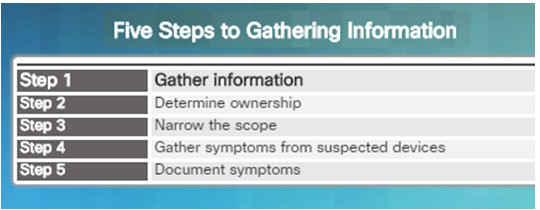
It is of import to gather facts and evidence that will allow you lot to progressively eliminate possible causes, and eventually identify the root cause of the issue.
There are five information gathering steps:
Stride 1. Gather Information
- Gather information from the trouble ticket, users, or finish systems affected by the problem to form a definition of the problem.
Step ii. Determine buying
- If the problem is inside the control of the system, movement onto the next stage. If information technology is outside of the boundary of organizational control, contact an administrator for the external system.
Step 3. Narrow the scope
- Make up one's mind if the problem is at the core, distribution, or access layer.
- At the identified layer, analyze the existing symptoms and try to determine which piece of equipment is virtually probable the cause.
Stride 4. Get together symptoms from suspect devices
- Using a layered troubleshooting approach, gather hardware and software symptoms from the doubtable devices.
- Is it a hardware of software configuration problem?
Stride 5. Document symptoms
- If the problem cannot be solved using the documented symptoms, begin the isolating phase of the general troubleshooting process.
- Assemble symptoms from devices using commands/tools including: ping, traceroute, telnet, show, debug, device logs and bundle captures.
8.1.2.three – Questioning End Users
In many cases, the problem is reported past an end user. This information may often be misleading or vague.
This may require asking questions of end users to better assist make up one's mind what the trouble is.
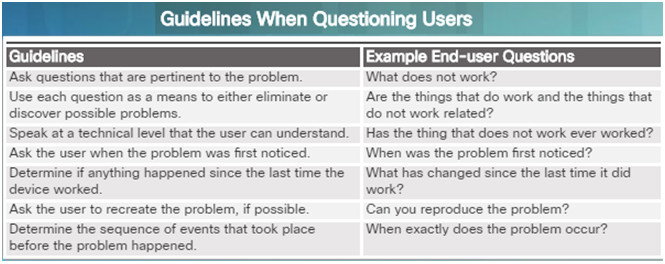
Use effective questioning techniques when request the end users about a network problem they may be experiencing.
The table to the left provides some guidelines and sample end-user questions.
8.ane.3 – Isolating the Issue Using Layered Models
8.i.3.1 – Using Layered Models for Troubleshooting
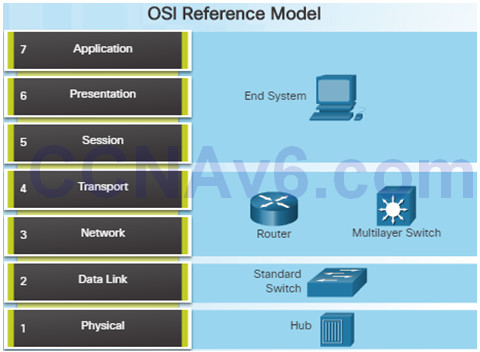
If no solution is identified, the network administrator compares the characteristics of the problem to the logical layers of the network to isolate and solve the issue.
The OSI reference model provides a common linguistic communication for network administrators and is unremarkably used in troubleshooting networks.
Issues are typically described in terms of a given OSI model layer.
The OSI reference model describes how data from a software application in one computer moves through a network to a software application in another calculator.
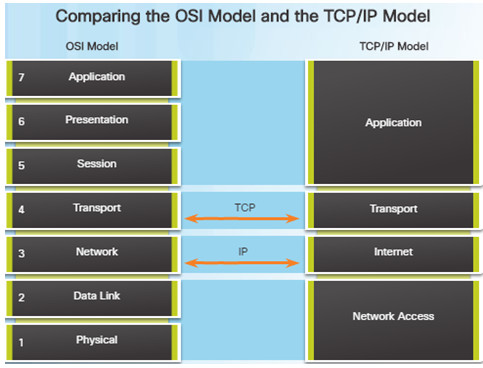
Similar to the OSI networking model, the TCP/IP networking model also divides networking architecture into modular layers.
The effigy to the left shows how the two models map to each other.
The application layer in the TCP/IP suite combines the functions of the three OSI model layers: session, presentation, and application.
The TCP/IP network access layer corresponds to the OSI physical and data link layers.
8.one.3.2 –Troubleshooting Methods
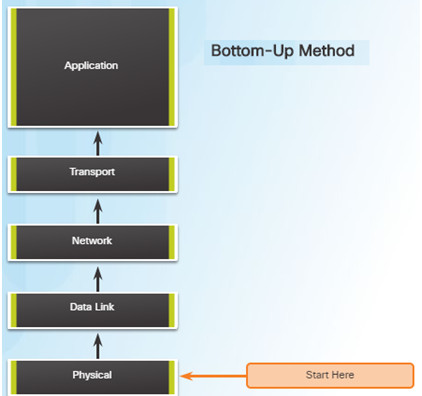
Using the layered models, at that place are iii primary methods for troubleshooting networks and each has its advantages and disadvantages:
- Bottom-up
- Top-downwardly
- Divide-and-conquer
Bottom-up Troubleshooting Method
- Start with the physical components of the network and move up through the layers of the OSI model until the cause of the problem is identified
- This is a skilful approach to utilize when the problem is suspected to be a physical i.
- Near networking problems reside at the lower levels, so using this method is often effective
- The disadvantage with this method is it requires that y'all check every device and interface on the network until the cause of the problem is found.
Top-Downward Troubleshooting Method
- This method starts with troubleshooting the end-user applications and moves downward through the layers of the OSI model until the crusade of the problem has been identified.
- End-user applications are tested before tackling the more specific networking pieces.
- Use this arroyo for simpler problems.
- The disadvantage is that it requires checking every network application until the problem is found.
Carve up-and-Conquer Troubleshooting Method
- The network administrator selects a layer and tests in both directions from that layer.
- Start past collecting user experiences of the problem, document the symptoms, and and so, using that information, make an informed judge as to which OSI layer to outset your investigation.
- If a layer is functioning properly, all layers below can be causeless to be functioning.
viii.one.3.3 – Other Troubleshooting Methods
In addition to the systematic, layered arroyo to troubleshooting, there are also, less-structured approaches.
- Educated gauge by the network administrator
- Guess is based on the symptoms of the problem
- This is more than successful when implemented by seasoned network administrators who tin can rely on their extensive knowledge and experience
Comparison a working and not-working situation
- Look for differences betwixt configurations, software versions, and hardware and other device properties.
- This method can be helpful when the network ambassador is lacking an area of expertise or when the problem needs to be resolved quickly.
Exchange
- Involves swapping the problematic devices with known, working ones.
- If the trouble remains, the network administrator knows to wait elsewhere.
8.1.iii.four – Guidelines for Selecting a Troubleshooting Method
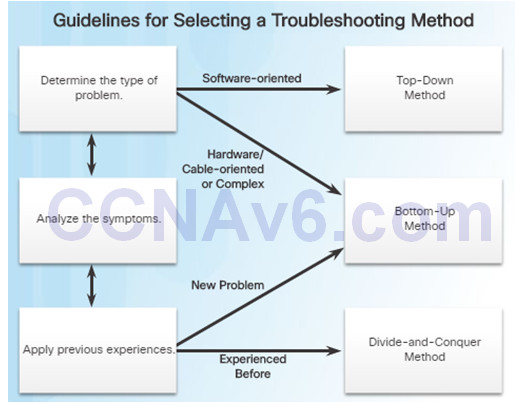
To chop-chop resolve network bug, accept the time to select the most effective network troubleshooting method. An example:
- Two IP routers are not exchanging routing information.
- The last fourth dimension this blazon of trouble occurred, it was a protocol issue.
- Therefore, choose the divide-and-conquer troubleshooting method.
- Analysis reveals that there is connectivity between the routers.
- Start the troubleshooting process at the physical or data link layer.
- Confirm connectivity and begin testing the TCP/IP-related functions at the next layer up in the OSI model, the network layer.
8.ii – Troubleshooting Scenarios
8.2.1 – Using IP SLA
viii.2.one.1 – IP SLA Concepts
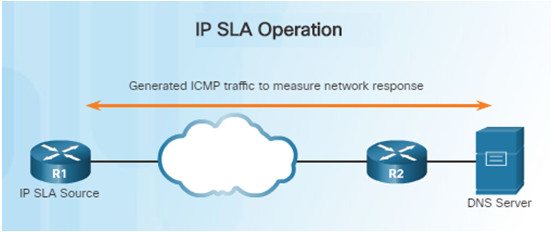
In the effigy to a higher place, R1 is the IP SLA source that monitors the connection to the DNS server by periodically sending ICMP requests to the server.
Network administrators must discover network failures as early as possible.
- A useful tool for this task is the Cisco IOS IP Service Level Agreement (SLA).
- IP SLAs use generated traffic to measure network performance between two networking devices, multiple network locations, or across multiple network paths.
Network engineers use IP SLAs to simulate network information and IP services to collect network performance information in existent fourth dimension.
Additional benefits for using IP SLA'due south include:
- SLA monitoring, measurement, and verification
- Monitoring to provide continuous, reliable, and anticipated measurements (jitter, latency, bundle loss)
- IP service network health assessment to verify that the existing QoS is sufficient for new IP services.
8.ii.one.2 – IP SLA Configuration
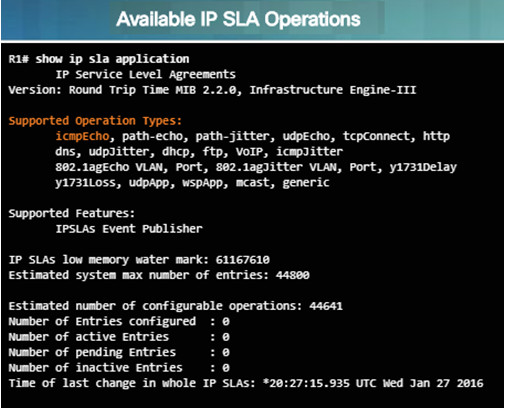
Instead of using ping manually, a network engineer can utilize IP SLA ICMP Echo performance to exam the availability of network devices.
The IP SLA ICMP Echo operation provides the following measurements:
- Availability monitoring (packet loss statistics)
- Performance monitoring (latency and response time)
- Network operation (end-to-end connectivity)
southward how ip sla application – this privileged EXEC fashion command verifies that the desired IP SLA functioning is supported on the source device.
- The output in the figure confirms that R1 is capable of supporting IP SLA. Still, there are no sessions configured.
To create an IP SLA operation and enter IP SLA configuration mode, apply the ip sla operation-number global configuration command.
- The operation number is a unique number that is used to identify the operation beingness configured.
From IP SLA config mode, you can configure the IP SLA operation as an ICMP Echo operation and set up the frequency rate:
- Router(config-ip-sla)#icmp -echo{dest – ip -address|dest -hostname } [source- ip {ip -address |hostname } |source-interfaceinterface-id ]
- Router(config)#ip sla schedule operation-number[life{forever|seconds}] [commencement-time{hh:mm[:ss ] [month day|twenty-four hour period month ] |pending|at present|afterwards hh:mm:ss ] [ageout seconds ] [recurring ]
8.2.one.3 – Sample IP SLA Configuration
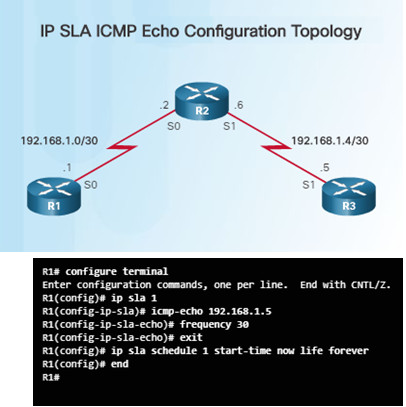
To help understand how to configure a elementary IP SLA, refer to the figure and configuration commands to the left.
The configuration commands demonstrate how to configure an IP SLA operation with an operation number of 1.
- Multiple IP SLA operations may exist configured on a device. Each operation can exist referred to past its performance number.
- The icmp -echo command identifies the destination address to be monitored.
- The frequency command is setting the IP SLA charge per unit to 30 second intervals.
The ip sla schedule command is scheduling the IP SLA operation number 1 to outset immediately and continue until manually cancelled.
eight.2.1.iv – Verifying an IP SLA Configuration
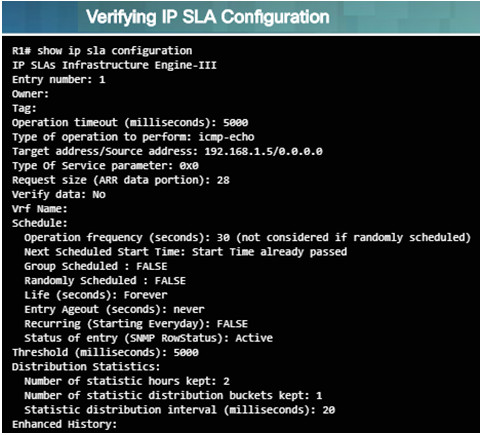
- Use theshow ip sla configuration operation-number command to display configuration values
- In the figure to the left, the show ip sla configuration command displays the IP SLA ICMP Echo configuration.
- Use theshow ip sla statistics[operation-number] control to display the IP SLA performance monitoring statistics.
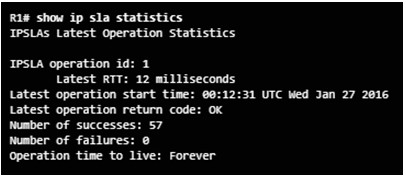
8.2.1.five – Verifying an IP SLA Configuration
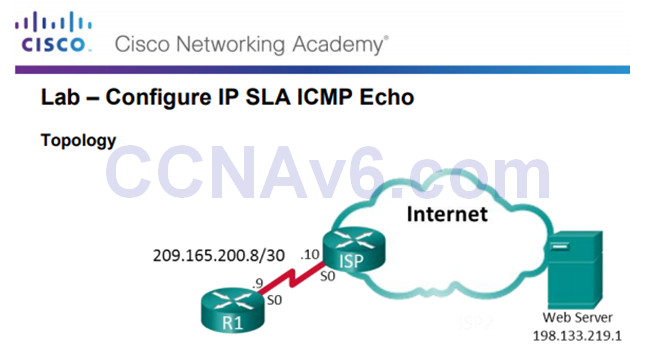
An outside vendor has been contracted to provide web services for your company.
As the network ambassador, you have been asked to monitor the vendor's service.
Y'all decide to configure IP SLA to help with that chore.
8.2.two – Troubleshooting Tools
eight.ii.2.1 – Software Troubleshooting Tools
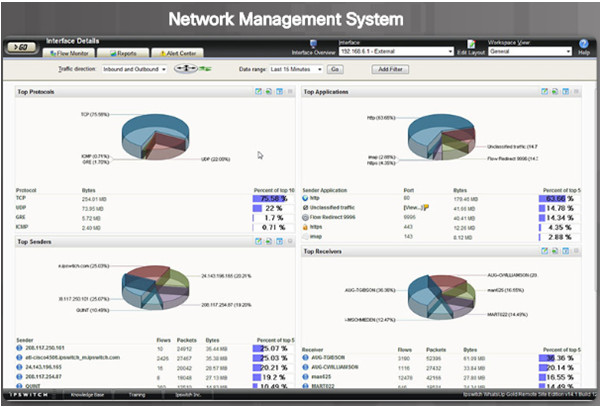
Common software troubleshooting tools include these:
Network Direction System Tools
- NMS tools include device-level monitoring, configuration, and fault-management tools.
- These graphical tools tin can be used to investigate and right network issues.
Knowledge Bases
- On-line network device vendor knowledge bases are very useful.
- When vendor-based knowledge bases are combined with Internet search engines, a network ambassador has access to a vast puddle of feel-based information.
Baselining Tools
- Many tools for automating the network documentation and baselining process are bachelor. For example:
- SolarWinds Network Performance Monitor
8.two.2.2 – Protocol Analyzers
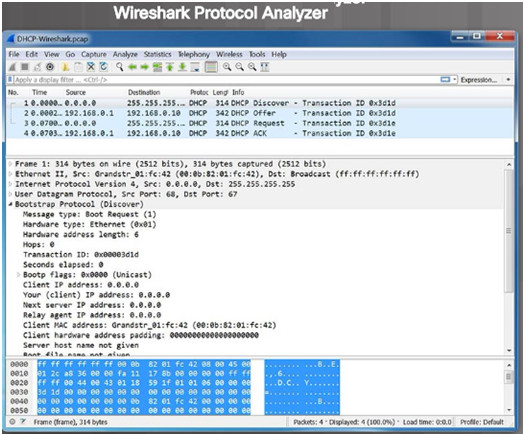
Protocol analyzers are useful to investigate packet content while the content is flowing through the network.
A protocol analyzer decodes the diverse protocol layers in a recorded frame and presents it in an piece of cake to utilize format.
The effigy to the left shows a screen capture of the Wireshark protocol analyzer.
Nigh protocol analyzers can filter traffic that meets certain criteria. For instance, all traffic to and from a particular device can exist captured.
Protocol analyzers are very helpful in troubleshooting network operation problems.
8.2.2.3 – Hardware Troubleshooting Tools
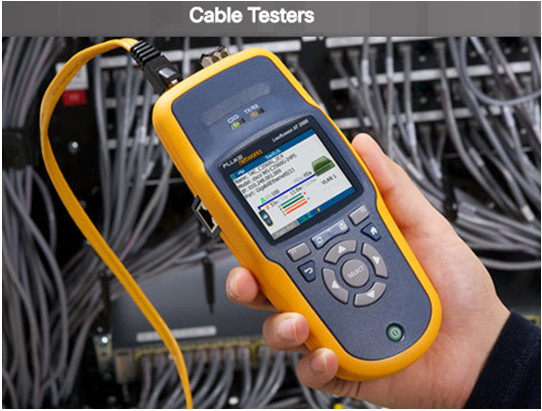
In that location are multiple types of hardware troubleshooting tools including:
- Digital Multimeters are test instruments that are used to directly measure electrical values of voltage, current, and resistance.
- Cable Testers are specialized handheld devices designed for testing the various types of data advice cabling. They tin can be used to observe broken wires, crossed-over wiring, shorted connections, and improperly paired connections. More expensive time-domain reflectometers (TDRs) are used to pinpoint the altitude to a break in a cable.
- Cablevision Analyzers are multifunctional handheld devices that are used to test and certify copper and fiber cables for different services and standards.
Portable Network Analyzers are used for troubleshooting switched networks and VLANs.
- By plugging the network analyzer in anywhere on the network, a network engineer can see the switch port to which the devices is connected.
- They can as well meet the boilerplate and peak utilization likewise equally the VLAN configuration.
Network Analysis Module – The Cisco NAM is a device or software.
- It provides an embedded browser-based interface that generates reports on the traffic that consumes critical network resources.
- The NAM can capture and decode packets and track response times to pinpoint an application problem to a particular network or server.
8.ii.2.4 – Hardware Troubleshooting Tools
Cisco devices can transport log letters to several unlike facilities including:
- Console
- Terminal lines
- Buffered logging
- SNMP traps
- External Syslog service
Syslog is a simple protocol used by an IP device known as a syslog client to send text-based log letters to another IP device known as the syslog server.
Implementing a logging facility is a very important part of network security and also for network troubleshooting.
Cisco devices can log various types of information including configuration changes, ACL violations, interface status, and many other types of events.
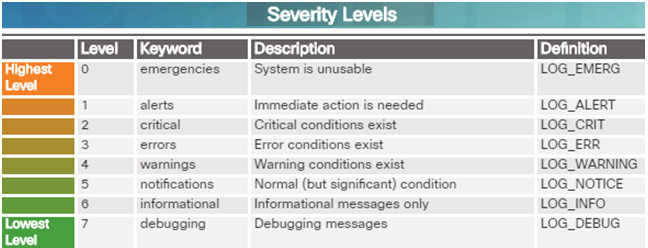
Cisco IOS log messages fall into i of viii levels as shown in the figure to the left. The lower the level number, the college the severity level.
eight.ii.3 – Symptoms and Causes of Network Troubleshooting
eight.ii.3.i – Concrete Layer Troubleshooting
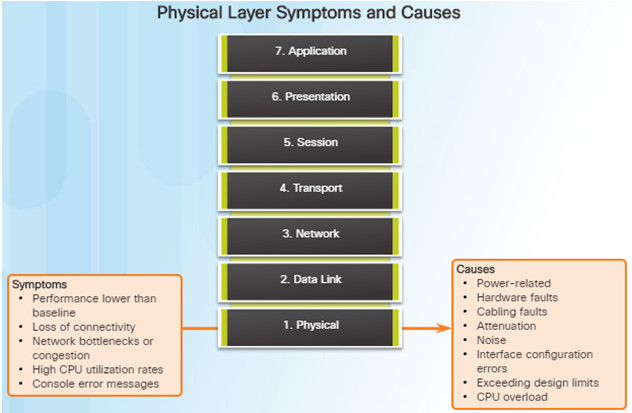
The concrete layer is the merely layer with physically tangible properties, such as wires, cards, and antennas.
Problems on a network often present as functioning problems.
Because the upper layers of the OSI model depend on the concrete layer to function, a network ambassador must have the ability to finer isolate and correct problems at this layer.
Common symptoms of network issues at the physical layer include:
- Performance lower than baseline
- Loss of connectivity
- Network bottlenecks or congestion
- High CPU utilization rates
- Panel error messages
Issues that commonly crusade network bug at the concrete layer include:
- Power-related
- Hardware faults
- Cabling faults
- Attenuation
- Dissonance
- Interface-configuration errors
- Exceeding pattern limits
- CPU overload
eight.2.3.ii – Data Link Layer Troubleshooting
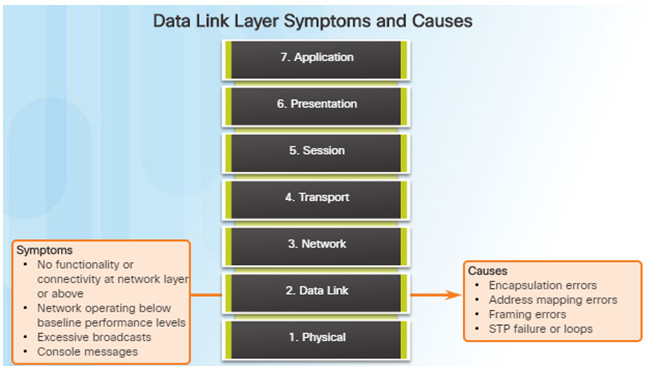
Troubleshooting Layer two problems can exist a challenging process.
Layer ii problems cause specific symptoms that, when recognized, will aid identify the problem speedily:
- No functionality or connectivity at the network layer or to a higher place
- Network is operating below baseline performance levels
- Excessive broadcasts
- Most mutual Layer 2 panel message is: "line protocol down"
Issues at the data link layer that normally result in network connectivity or performance bug include these:
- Encapsulation errors
- Encapsulation at one end of a WAN link is configured differently from that on the other end.
- Address mapping errors
- In a point-to-multipoint or broadcast Ethernet topology, it is essential that an advisable Layer two destination address be given to the frame.
- Framing errors
- A framing fault occurs when a frame does not finish on an 8-fleck byte purlieus.
- Spanning Tree Protocol (STP) failures or loops.
- Most STP issues are related to forwarding loops that occur when no ports in a redundant topology are blocked and traffic is forwarded in circles indefinitely.
8.ii.3.three – Network Layer Troubleshooting
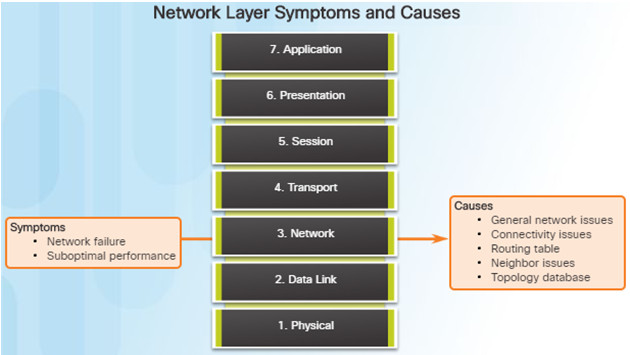
Network layer problems include any trouble that involves a Layer iii protocol (routed or routing protocols)
Common symptoms of network layer bug:
- Network failure
- Suboptimal performance
Areas to explore when diagnosing a possible problem involving routing protocols:
- General network issues
- Connectivity problems – Likewise bank check for Layer one or power issues
- Routing table issues – employ debug
- Neighbor problems – cheque for adjacencies if used
- Cheque the routing table topology database
8.two.3.4 – Ship Layer Troubleshooting – ACLs
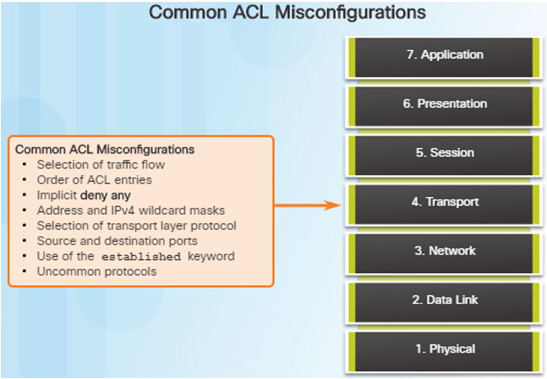
Network problems can arise from send layer bug on the router. Improper ACL configuration issues might include:
- Wrong pick of traffic menstruation (entering/outbound)
- Wrong order of access control entries
- Implicit deny any
- Misconfiguration of addresses and IPv4 wildcard masks
- Selecting both UDP and TCP protocols when unsure
- Incorrect source and destination ports
- Incorrect utilize of the established keyword
- Misconfiguration of uncommon protocols such every bit VPN and encryption protocols
8.ii.3.5 – Transport Layer Troubleshooting – NAT for IPv4
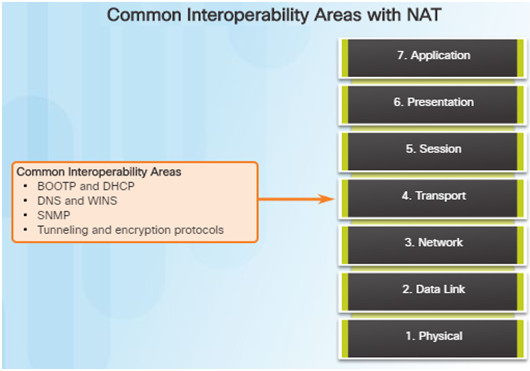
In that location are a number of problems with NAT such as not interacting with services like DHCP and tunneling.
These tin include misconfigured NAT inside, NAT outside, or a misconfigured ACL.
Other issues include interoperability with other network technologies including:
- BOOTP and DHCP
- DNS
- SNMP
- Tunneling and encryption protocols
8.two.3.6 – Application Layer Troubleshooting
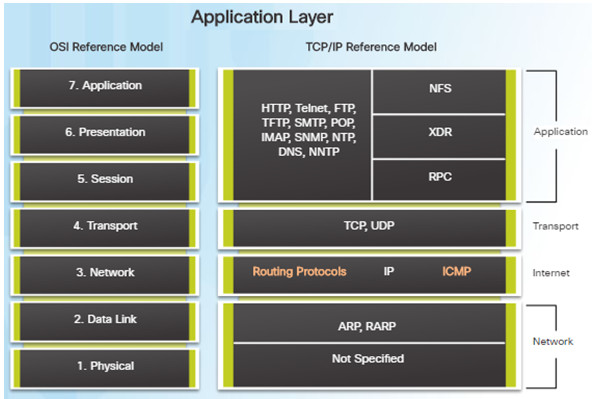
Most of the application layer protocols provide user services for network management, file transfer, distributed file services, terminal emulation, and email.
The near widely known and implemented TCP/IP application layer protocols include:
- SSH/Telnet, HTTP, FTP, TFTP
- SMTP, Pop, SNMP, DNS, NFS
Application layer problems prevent services from being provided to awarding programs.
A problem at the application layer tin can result in unreachable or unusable resources when the physical, data link, network, and ship layers are functional.
viii.two.iv – Troubleshooting IP Connectivity
8.2.4.1 – Application Layer Troubleshooting
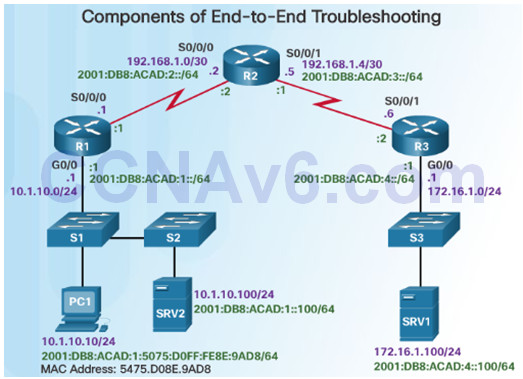
Past employing a structured approach to the troubleshooting process, an ambassador can reduce the fourth dimension it takes to diagnose and solve a problem.
Throughout this topic, the following scenario (come across effigy) is used. The client host PC1 is unable to access applications on server SRV1 or server SRV2.
PC1 uses SLAAC with EUI-64 to create its IPv6 global unicast accost. EUI-64 creates the Interface ID using the Ethernet MAC address, inserting FFFE in the heart, and flipping the seventh flake.
Hither are the steps an administrator can have when troubleshooting with the bottom-upwards arroyo:
Step 1.Check physical connectivity at the point where network communication stops.
Pace 2.Cheque for duplex mismatches.
Step three.Bank check information link and network layer addressing on the local network.
Step 4.Verify that the default gateway is correct.
Pace 5.Ensure that devices are determining the right path from the source to the destination. Manipulate the routing information if necessary.
Stride 6.Verify that the send layer is functioning properly (Telnet tin can exist used).
Step seven.Verify that in that location are no ACLs blocking traffic.
Step 8.Ensure that DNS settings are correct. There should be a DNS server that is attainable.
8.ii.4.2 – Terminate-to-Terminate Connectivity Problem Initiates Troubleshooting
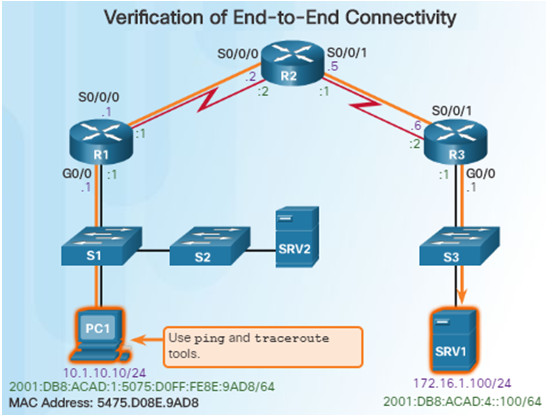
Ping and traceroute are the two nigh common utilities to test end-to-end connectivity.
The ping command uses a Layer 3 protocol that is a part of the TCP/IP suite called ICMP.
- ping uses the ICMP echo request and ICMP echo reply packets.
- p ing can be used for IPv4 and IPv6
The traceroute command illustrates the path the IPv4 packets take to reach their destination.
- The Cisco IOS traceroute control tin can be used for both IPv4 and IPv6
- The tracert command tin can be used on Windows
The traceroute command is normally performed when the ping command fails.
8.2.4.3 – Step 1 – Verify the Physical Layer
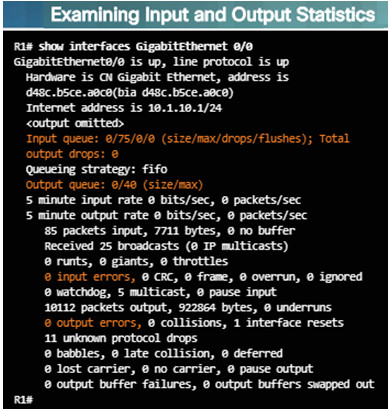
When a network administrator determines that a problem exists on a given device, and that problem might exist hardware-related, information technology is useful to verify its operation using the following IOS commands:
- due south how processes cpu
- s how retentiveness
- southward how interfaces
When troubleshooting performance-related issues and hardware is suspected to be at fault, use the testify interfaces command. The output volition show the following:
- Input queue drops
- Output queue drops
- Input errors
- Output errors
8.2.4.iv – Stride 2 – Check for Duplex Mismatches
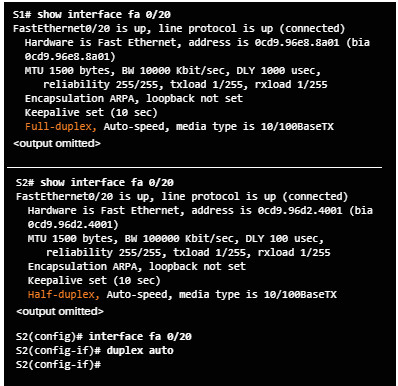
Duplex mismatch betwixt two ends of an Ethernet link is another common cause for interface errors.
The IEEE 802.3ab Gigabit Ethernet standard mandates the use of autonegotiation for speed and duplex. Most Fast Ethernet NICs likewise use autonegotiation past default.
Nonetheless, if duplex negotiation fails for some reason, information technology might be necessary to set the speed and duplex manually on both ends.
Signal-to-point Ethernet links should always run in full-duplex mode.
The utilize of autonegotiation for speed and duplex is the current recommended practice.
viii.ii.4.five – Step 3 – Verify Layer 2 and Layer 3 Addressing on the Local Network
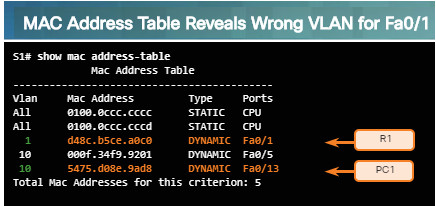
Wait for VLAN assignment issues when troubleshooting finish-to-end connectivity issues using the show vlan command on a switch.
The output of the bear witness mac address-tabular array command tin also exist helpful when looking for VLAN assignment issues. This control is used to brandish the MAC accost tabular array on the switch, simply likewise includes VLAN information.
The arp Windows control can be used to assist verify mappings between destination IP addresses and Layer 2 Ethernet addresses.
- The arp –d command can be used to clear the arp enshroud and allow it to repopulate with updated info.
The netsh interface ipv6 show neighbor Windows command will list all devices that are currently in the neighbor table.
- By examining the neighbor tabular array, the network ambassador can verify that the destination IPv6 addresses map to correct Ethernet addresses.
The testify ipv6 neighbors command can be used on a Cisco IOS router.
8.two.iv.6 – Step four – Verify Default Gateway
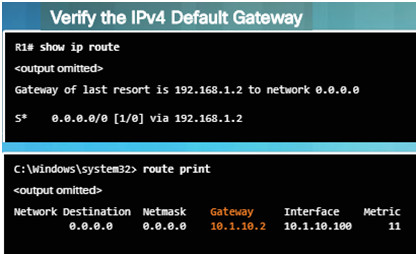
These commands will assistance verify the presence of the IPv4 default gateway.
If there is no default route on the router or if the host is configured with the wrong default gateway, then communication betwixt 2 endpoints on different networks will not work.
In addition to the commands in the effigy, the following tin can be useful when troubleshooting:
- Use the evidence ipv6 route Cisco IOS command to bank check for the IPv6 default route on R1 and use the ipconfig Windows command to verify if a PC has an IPv6 default gateway
- The prove ipv6 interface GigabitEthernet 0/0 command can verify if it is a fellow member of the correct multicast grouping.
- Employ the ipconfig command on Windows PCs to verify if the right default gateway is set.
8.2.4.seven – Verify Correct Path
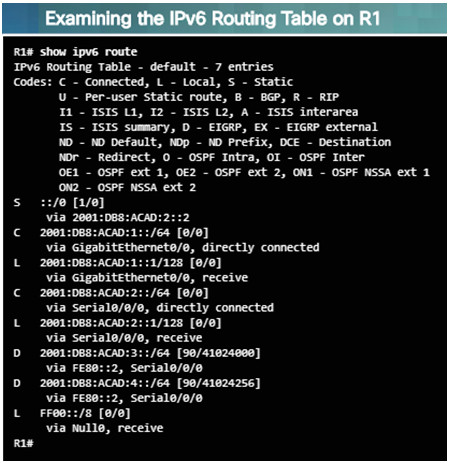
When troubleshooting a connectivity effect, it is often necessary to verify the path to the destination network.
Apply either the show ip road or show ipv6 route command to verify that the route exists to the destination device/network.
The process of forwarding IPv4 and IPv6 packets is based on the longest chip match or longest prefix match. If the destination address in a packet:
- Does non lucifer an entry in the routing table, then the default route is used. If there'due south no default route, the package is discarded.
- Matches a unmarried entry in the routing table, so the packet is forwarded through the interface that is defined in this route.
- Matches more than one entry in the routing table and the routing entries accept the same prefix length, then the packets for this destination can be distributed amid the routes that are divers in the routing tabular array.
8.2.4.8 – Verify the Transport Layer
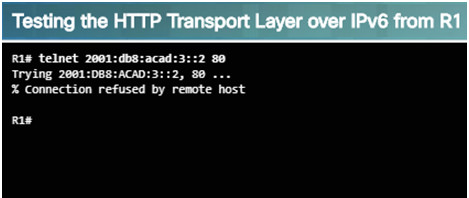
The output to a higher place shows a successful Telnet connexion from R1 to R3, over IPv6 using port 80.
The output verifies a successful send layer connection.
If the network layer appears to be functioning as expected, merely users are notwithstanding unable to admission resource, and so the network ambassador must begin troubleshooting the upper layers.
The two most mutual issues that affect send layer connectivity are ACL and NAT configuration problems.
A common tool for testing send layer functionality is the Telnet utility.
If a ping is successful to a server, then the network administrator knows that all layers below the network layer, between the user and the server are operational.
- The administrator knows the issue is with Layer 4 or upwardly.
For example: R1# telnet 2001:db8:acad:3::two
viii.2.4.nine – Footstep 7 – Verify ACLs
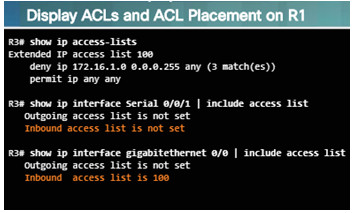
On routers, there may be ACLs configured that prohibit protocols from passing through the interface in the inbound or outbound direction. Utilize the following commands to display the contents of all ACLs:
- s how ip access-lists
- southward how ipv6 admission-list
Use the following commands to see if in that location are ACLs set on a item interface:
- s how ip interfaces
- s how ipv6 interfaces
8.2.4.10 – Step 8 – Verify DNS
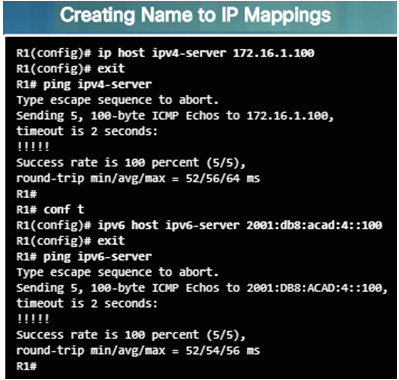
The DNS protocol controls the DNS, a distributed database with which you can map hostnames to IP addresses.
When DNS is configured on a device, you can substitute the hostname for the IP address for all IP commands including ping and telnet.
If there is no DNS server configured on a device, you tin can employ the ip host command to enter name to IPv4 mappings on a switch or router.
The ipv6 host command is used for IPv6.
The figure to the left demonstrates the use of these commands.
8.ii.four.12 – Bundle Tracer – Troubleshooting Enterprise Networks 1
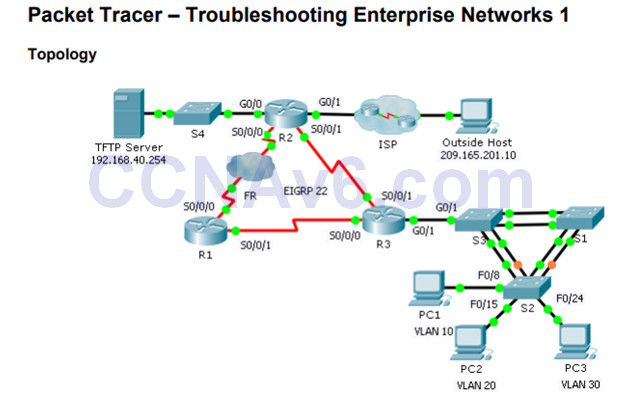
This activity uses a variety of technologies you have encountered during your CCNA studies, including VLANs, STP, routing, inter-VLAN routing, DHCP, NAT, PPP, and Frame Relay.
You volition be tasked with reviewing the requirements, isolating and resolving any issues, as well equally documenting the steps you took to verify the requirements.
8.ii.iv.13 – Bundle Tracer – Troubleshooting Enterprise Networks 2
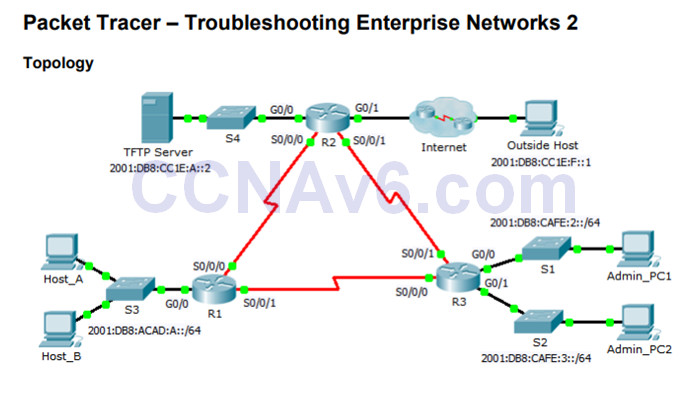
This activity uses IPv6 configurations that include DHCPv6, EIGRPv6, and IPv6 default routing.
Your task is to review the requirements, isolate and resolve any problems, and and so document the steps you took to verify the requirements.
8.2.4.xiv – Packet Tracer – Troubleshooting Enterprise Networks 3
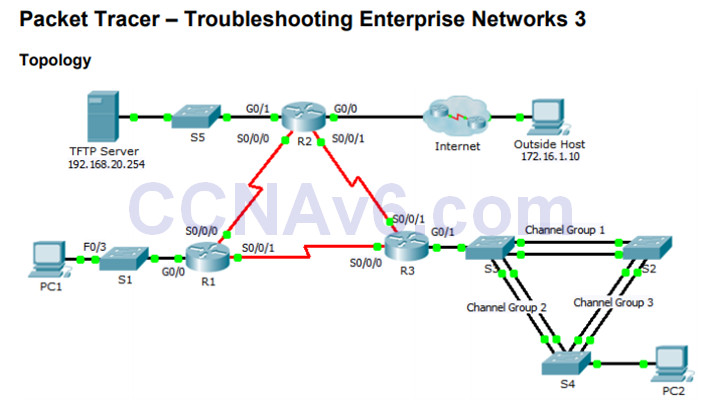
This activity uses a diverseness of technologies you accept encountered during your CCNA studies, including routing, port security, EtherChannel, DHCP, NAT, PPP, and Frame Relay.
Your job is to review the requirements, isolate and resolve any issues, and then document the steps you took to verify the requirements.
8.2.4.xv – Package Tracer – Troubleshooting Challenge – Using Documentation to Solve Issues
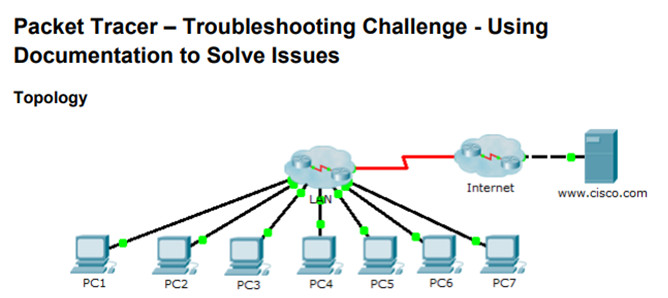
This is Part Two of a two-function activity.
Part I is Packet Tracer – Troubleshooting Challenge – Documenting the Network, which you should have completed earlier in the chapter.
In Part 2, you volition utilize your troubleshooting skills and documentation from Function I to solve connectivity issues between PCs.
8.3 – Summary
viii.3.ane – Conclusion
8.iii.one.1 – Affiliate 8: Network Troubleshooting
Explain troubleshooting approaches for various network problems.
Troubleshoot end-to-end connectivity in a small-scale to medium-sized business concern network, using a systematic approach.
8.3.1.2 – Packet Tracer – CCNA Skills Integration Challenge
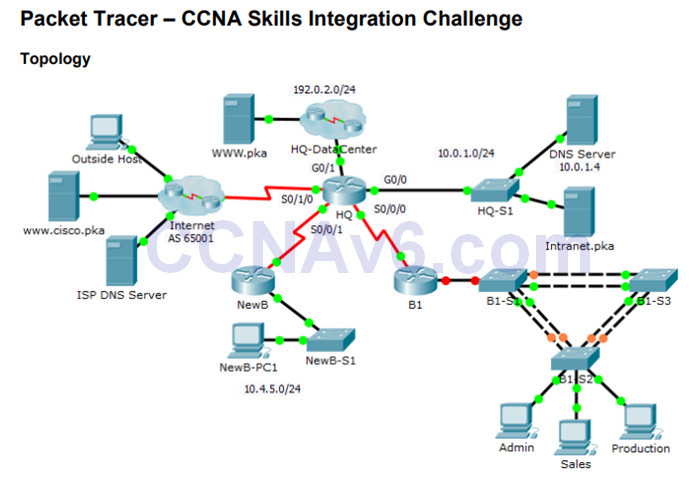
In this comprehensive CCNA skills activity, the XYZ Corporation uses a combination of eBGP and PPP for WAN connections.
Other technologies include NAT, DHCP, static and default routing, EIGRP for IPv4, inter-VLAN routing, and VLAN configurations. Security configurations include SSH, port security, switch security, and ACLs.
This action volition require the configuration of these technologies as well as verification for total connectivity from each PC to the spider web servers.
Download Slide PowerPoint (pptx)
[sociallocker id="54558″]
[/sociallocker]
Source: https://itexamanswers.net/connecting-networks-v6-0-chapter-8-network-troubleshooting.html

Post a Comment for "Protocol Analyzers Can Help Solve Problems From the Data Link Layer Up to the Application Layer."